
Joan Bolton King
We wanted to enjoy a day's practical enamelling and experiment on something new - so we decided to find out if we could manipulate liquid enamels while they were still wet, straight on to the copper.
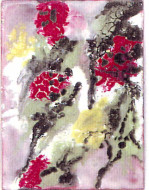
This summarises what we did, using John Ball's wet process flux, coloured enamels and steel white.
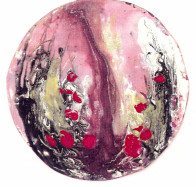
Maureen Carswell
On the previous visit we had all been impressed with the glue which they used to stick the wires in place. We had been told that it was made of hyacinth root, also used as a heart medicine. I had not obtained any of this, much to the disappointment of Guild members who practice cloisonné, so I decided to try to remedy this. I had kept in touch with Julia Guo, our guide on the previous visit. She came to see me at the hotel on one of her free afternoons. In the evening, over a meal with Dr. Shia, we discussed the matter of the glue and Julia was able to give Dr. Shia the name. After saying "Goodbye" to Julia, we went hot foot to the nearest pharmacy (Open all Hours!), but were disappointed. The following afternoon, however, Dr. Shia arrived at my room with a triumphant smile and presented me with a bag of dried root pieces (Bai Ji - Rhizoma Bletillae). I did say, rather ruefully that the glue which I had seen was in powdered form, to which he cheerfully replied - "Experiment".
Eileen Schneegas
"Don't panic, it will be all right" and similar sentiments were the bywords of the day from our tutor, Dayna White. If you are unfamiliar with the peculiarities of painting enamel, the reason for the reassurances will become clear (one hopes) by the end of this article!
Dayna is an exquisite artist in the painting technique. Examples of her work were on show at our conference. Dayna is also a lovely person, kind and willing to share her knowledge.
On receipt of my equipment list, I rang up Sarah at Vitrum Signum. I ordered the set of Sunshine painting enamels, a high firing white (Blythe T6) & Latham 232 silver flux. At present, Sunshine has no pink or lilac colours for skin tones. Sarah has promised to research further for more colours.
There was research done after Dayna's first tutorial, at the Leicester conference. The old painting enamels (PPE) & other various brands are no longer being made. And neither is the white ground colour, hence a switch to something available. Students were advised to enamel with the ground white at home on copper or silver of around 2 or 3 inches in size.
Of the 2 pieces I attempted in class, one of them developed a crack. This was probably because I managed to fumble it whilst it was hot & drop it. But the white undercoat is important. Too hard a white will likely develop cracks and crazes after repeated firing of the painting enamel layers. I found that I needed to fire the T6 at 1500 ºF/l000+ºC to get an even coat. I did 2 coats, sifted, and stoned in between. So long as you are planning to paint over most of the ground colour, a few specks will not show once you are finished. If you choose to keep the white background free of any other colours, then you would need to be very sure of clean colour. Any pits should certainly be mended before applying the layers of coloured enamel.
Dorothy Cockrell
Following my researches on raku firing of copper bowls (reported in the Journal, issue Winter 2000, page 27), I have been trying the technique on various types of silver. Not silver bowls of course, but small bits of scrap.
Since the colour develops from an oxide on the metal dissolving into clear flux, the chosen metal must form an oxide. Sterling silver is well known to form one - commonly known as 'fire stain' (and several other less printable names), from the copper which it contains.
Harry Nicholson
From the pieces I entered at Conference (2001), I favour two above the rest. What follows are my notes for those pieces, the notes were part of the entry.
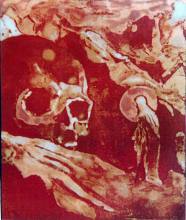
Skull of the Giant (March 2001)
The Russian born painter Nicholas Roerich 1874-1947 used colour and imagery in a way that I find richly metaphoric. I wished to echo something of his style with enamel.
I have taken a detail of his painting "Issa and the Skull of the Giant" (tempera on canvas 1933), Nicholas Roerich Museum, New York. This detail appeared suitable for interpretation with low fire technique using only flux and white, allowing fire-scale to form.