
Dennis Davies
The puzzle in this case was why did copper bowls spun in Birmingham throw off an enormous quantity of fire-scale, while similar bowls bought in the USA did not? Also, why do some small copper blanks do it and others do not?
'Aspects of Copper for the Enamellist' by Dennis Davies (in the Guild library) was consulted, but it only described the effect of temperature and water quenching on the formation of scale. A letter of enquiry to Dennis produced the following enlightenment:
"Thank you for presenting me with a metallurgical puzzle which I will try to unravel. These sort of things do brighten up one's life!
Notes and instructions from Dorothy Cockrell's Conference Workshop April 2001
Leaf is thinner and cheaper than foil. It is much more difficult to handle, but can give very subtle effects and will reticulate well.
-
Make the work space as draught free as possible and breathe carefully.
-
Take a sheet of tracing paper, fold it in two and then ease the leaf together with its own tissue paper into it. (The other sheets of leaf in the book can be held down with another scrap of paper.)
-
Lay the folded tracing paper flat with the leaf inside and draw the desired shape on it.
-
Cut or tear through all the layers of paper, then lay the whole thing carefully on the table with the side showing the tissue paper uppermost.
-
Remove the top layers of paper.
Molly Bullick
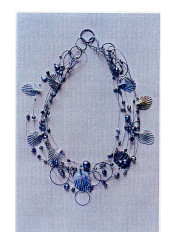
This is an account of experiments with enamel and Precious Metal Clay (PMC) by a person unfamiliar with enamelling. For those people who are in turn unfamiliar with PMC I will give a brief description of it and its properties.
PMC and a fairly recent development PMCplus is a material developed by Mitsubishi Materials Corporation in Japan. It resembles potters clay and can be shaped like clay. When fired in a kiln the organic binder which holds microscopic particles of precious metal burns out and leaves only pure gold or fine silver. The clay shrinks in the firing which accentuates impressed textures and decorative effects. This is indeed a very versatile material.
Michael Benedict
The turntable consists of 2 pieces of ¾" 4 ply wooden sheet approx. 9" diameter and 8" diameter. Three steel legs screwed to the 8" disc. Each leg is bent at the top to support a steel mesh sheet.
The two discs are separated by a flat bearing (a bearing from an old Black & Decker strimmer) - the top disc being allowed to turn around a swivel pin (¾" bolt & washers), large washers work just as well if well greased.
Tony Stephens
In an earlier paper, I described the development of a method of making enamel transfers using an inkjet printer. The purpose of this paper is to describe further experimentation which has broadened the range of transfer types made possible using the technique.
The basis of the technique is the printing of high contrast images on a slightly "tacky" paper (Unical from Pottery Craft, Tel: 01782 745000). The non-absorbent nature of the Unical retards the drying of the ink and, when enamel powder is dusted onto the paper, it will selectively adhere to the wet ink. Gentle sweeping of a feather across the surface will clean away all the enamel which is not "fixed" to the ink.
Since any artwork is likely to be much smaller than a standard sheet of A4, you need only use a piece of Unical which is slightly larger than the artwork, attaching it to the sheet which is to be fed into the printer with double sided tape. Modern micro dot printers use significantly less ink than was formerly the case, so, to give yourself as much time as possible to apply the enamel, it is worth positioning the artwork on the last part of the page to be printed.