
Joan Bolton King
Your experiments with sgraffito in liquid white enamel may already have given you an understanding of the effects produced by varying the depth of the enamel and the hardness of firing.
A useful series of tests
Nevertheless, it is worth undertaking an exercise with nine identical small pieces of copper. Cover them (by dipping in): 3 thickly, 3 to a medium depth and 3 thinly (using a water mix). When dry scribe 'THIN', and 'THICK' as appropriate into the enamel coat and add 'LOW FIRE', MEDIUM FIRE' and 'HIGH FIRE' to one of each thickness - then observe the way the enamel and lettering react to the specific types of firing. Keep these results for reference and, if you intend to try out different liquid enamels, it is useful to have noted the make on the reverse of the piece.
Of particular interest is the way greens and browns appear in thin coats and the metallic sheens developed with high firing. Sgraffito may lose its precise outlines and the overall outcome become less predictable, but designs can capitalise on the possible effects.
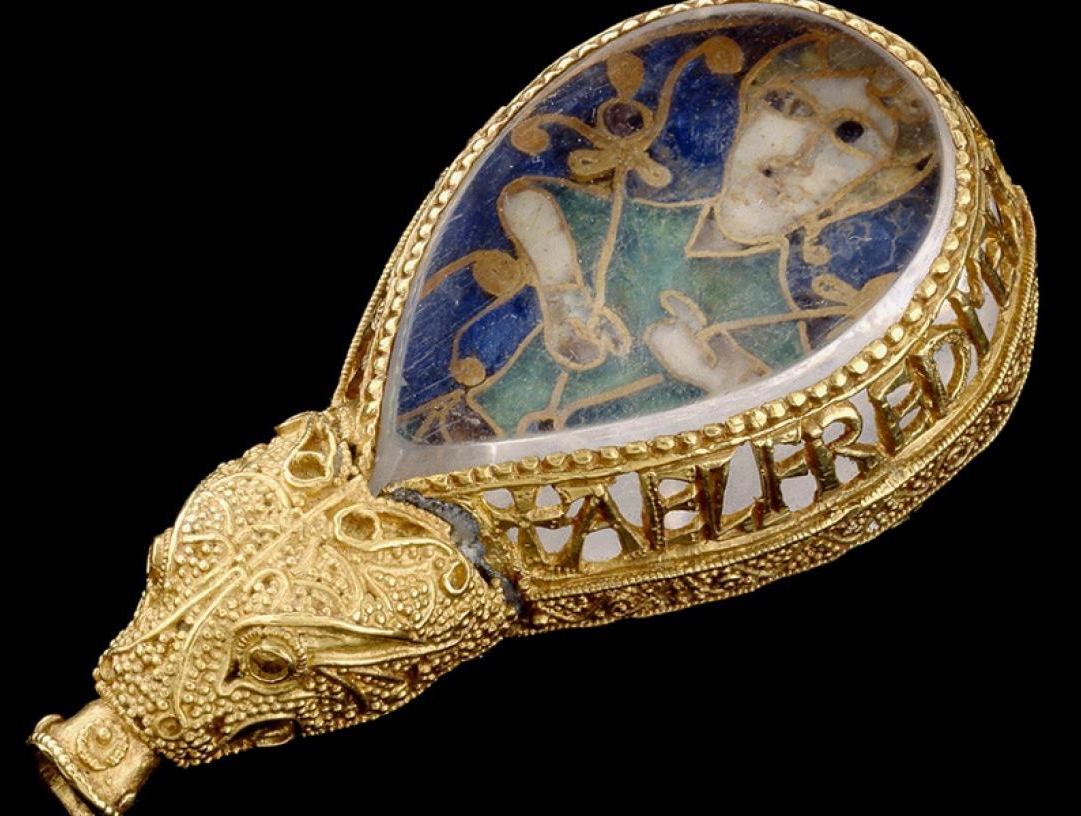
There are certain 'milestone' objects with enamel, in treasuries and museums in Britain, which feature in virtually all historic surveys. The famous Alfred Jewel is one of these.
This jewel is of tear-drop shape and it is composed of three elements: the superb granulated, animalistic gold setting, the rock crystal cover and the gold cloisonné plaque at its centre.
It was discovered in Newton Park, Somerset in 1693, and since 1718, it has been one of the great treasures of the Ashmolean Museum in Oxford.
Pat Johnson
Reproduced with permission from the B.S.O.E. Journal.
The chart below represents the results of comparative study of the behaviour of Latham and Soyer fluxes and one Blythe flux.
The fluxes tested were: -
T700, T6426, B139, Soyer 1, Soyer 2, Soyer 3, T200, Soyer 209, Soyer 518, Soyer 619, T232, T244
This unusual and ingenious piece was Carole's entry for the 'Weather' competition at last year's Conference. She has kindly lent her notes to the Journal, along with photographs of the 'wet', 'sunny and back views.
It is an articulated brooch inspired by weather symbols used by the media.
The enamelling techniques were Champlevé and Plique-a-jour.
with Doreen Jenkinson
by Nadja Snow
As a new member of the Guild and one with next to no experience of enamelling, I was delighted to find that this year's Conference was to take place in my region. As a beginner, my main interest was to try one of the workshops and, since I enjoy drawing, I decided that Doreen Jenkinson's Enamel Painting workshop wasn't a bad place to get started.