Kathleen Kay
Special Needs Students first attempts at Cloisonné Enamelling can be a fairly easy activity enabling children, under guidance, to produce a result that gives pleasure. The obvious method of embedding the usual enamel chips, threads, copper or glass mosaics, and, of course, millefiori, can produce a myriad of pattern variations, but there comes a point when these techniques can become wearing for the teacher. As you may imagine, sifting the enamel and laying the media takes only minutes – seconds with some students – and the piece is ready for the kiln again. I am referring to my sessions with Supported Learning teenagers, including disabled students who can’t use the kiln. These rely on the tutor to whizz the enamels in and out of the kiln whilst also helping and guiding other students. No wonder a few pieces are accidentally overfired.
Kathleen Kay
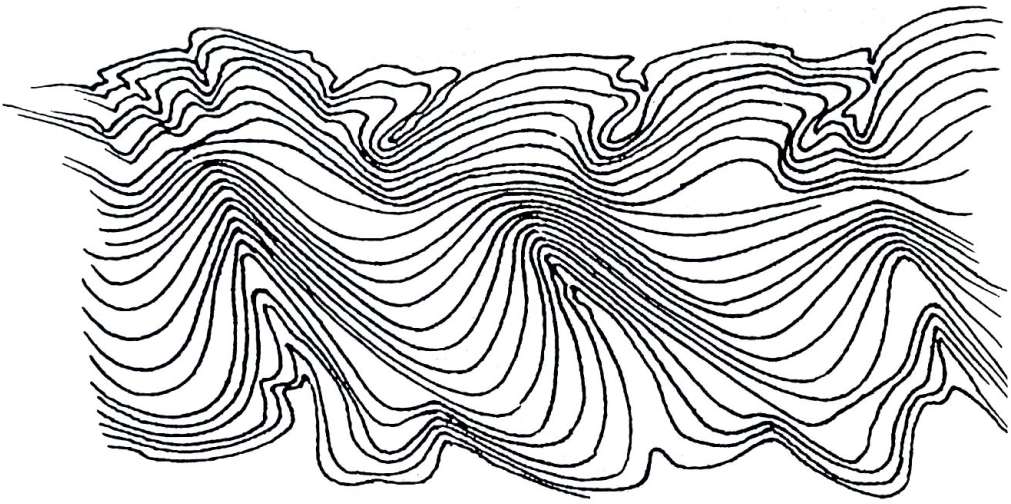
This follows on from the previous Journal showing how several lines, drawn each in relation to its neighbour, give the illusion of form, e.g. hills, valleys, growth or movement. Here I want to show how we can develop these ideas quite simply as inspiration for design.
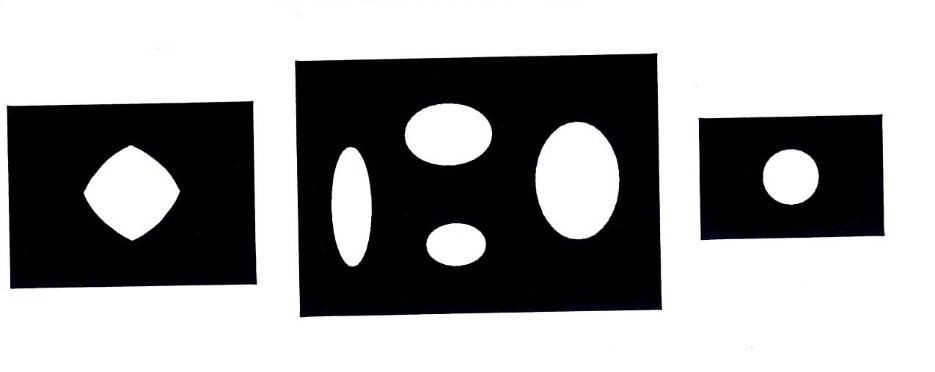
I often refer to masks which enable us to find and isolate areas for design. At its simplest, a mask is a piece of plain, coloured paper with a hole cut out corresponding to the exact shape and size of the copper we want to use. This is easily done by carefully tracing around the chosen copper shape before cutting out the hole.
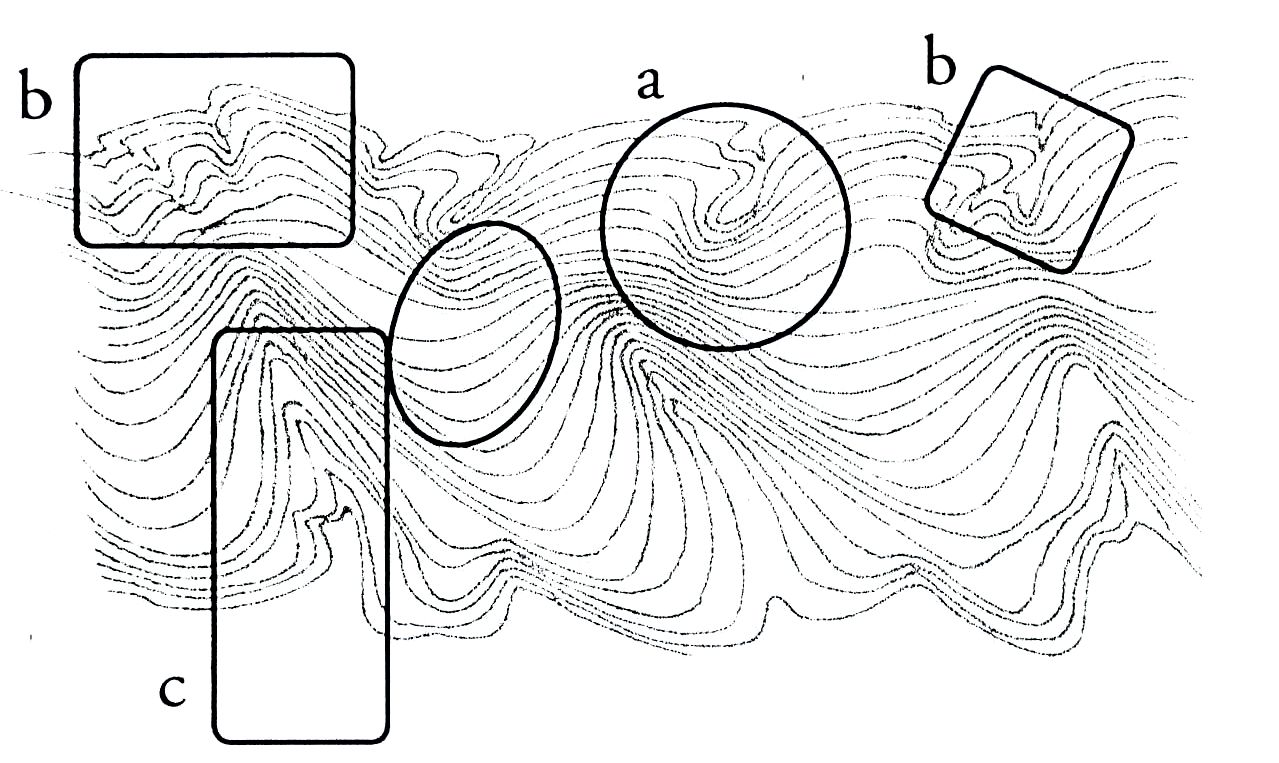
Kathleen Kay
This is as good an exercise as any to improve the co-ordination of eye, mind and hand. There are various ways that the best of our results can be an inspiration for enamelling. Rather than interpreting the complexities of a landscape, a portrait or a still-life, here we concentrate solely on each line at a time. Simple creative play just using a medium or fine marker pen, a drawing pad and a little peaceful time.
-
Start with a simple wavy line, drawn from left to right across the middle of your sheet.
-
From this central line work further lines above and below to create areas of darkness; where the lines lie close together, and lightness; where the spaces are wide.
Kathleen Kay
Creative play for beginners in design
Are you at a loss for a simple design idea when, with no references to hand, a teacher asks you first to draw a design for a new project; or maybe you just lack confidence in drawing or designing and prefer to get on quickly with the enamelling?
Our finished enamels, when done well, could survive for a great many years so it's worth spending a little time improving our design skills. A line drawn confidently with style is usually preferable to a hesitant one lacking direction.
A few sessions trying various methods of creative play, with the help of a few aids and a fine marker pen, in the privacy of your own fireside will add to your store of ideas and help boost your confidence in producing design sketches fairly quickly.
Our requirements are simple, an A4 pad — of inexpensive paper so that we don't mind wasting a few sheets: a fine marker pen, giving a line of similar thickness to that of a pencil, but immediately imparting more confidence: and small, sharp scissors or a scalpel (if not both) to cut thin plastic sheet or card.
Kathleen Kay
.....these are most useful design aids
A mask or isolator, in this context, is a piece of stiff coloured paper or thin card, with a hole defining the exact outside shape of the area we wish to design / enamel.