
Dorothy Cockrell
One of the fascinating things demonstrated at the recent International Symposium at Bristol was Raku firing of enamels to give a lustre finish.
It was done by taking a hot enamel out of the kiln, putting it straight into a tin of damp sawdust and slamming a lid on top. Coupled with very thin layers of enamel, this technique gave wonderfully coloured lustres. It could be done also by putting the hot enamel on a pad of damp newspaper and covering it with an airtight tin. The hot enamel sets fire to the sawdust or newspaper, the lid prevents more oxygen reaching the fire and the lack of oxygen produces a reducing atmosphere and so a lustre.
Sarah Wilson
After many months of letters and faxes and with the help of a Japanese colleague Vitrum Signum has at last stocks of the much talked of Kujaku Ruby Red 105A and Rich Ruby Red 105B on its shelves; and the wait – and sometimes frustration – was worth it.
My initial tests on copper and sterling silver were as I’d hoped. They can both be fired directly on silver to a true ruby red – the 105B just slightly darker than the 105A – without the adverse reaction normally associated with other transparent reds; what I called “Jamminess” with repeated firing as the colour gets denser and dead-looking. Applied over SOJE3 Silver Flux their colour can only be described as Cerise Pink, again the 105B a slightly deeper richer tone.
Tony Stephens
In recent years, Computer Aided Design (CAD) has been almost universally adopted throughout all fields of industrial engineering, whether the objects being designed are cars, aeroplanes, bridges or chemical plants.
The reason for the widespread adoption of the technique is that the initial time consuming process of having to transfer the design into a format which is recognisable by the computer is more than repaid by the ease with which the design may later be changed and displayed and output taken for downstream manufacture. CAD does not merely speed up the overall design process but actually enables complex interactive design processes which would otherwise not be possible. The purpose of this paper is to describe two applications of CAD to enamelling which produce results which would be difficult to achieve using more traditional methods.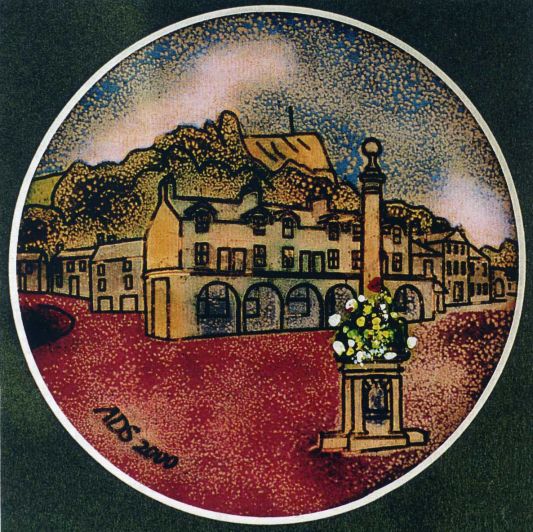
Held at the University of the West of England July 2000.
Deirdre McCrory
The three day workshop was held at the Faculty of Art, Media & Design at Bristol UWE (University of the West of England).
Day 1
We were given an introduction to the print making studios and an opportunity to see some recent prints - the result of collaboration with various artists and the print department.
with Richard Witek at Leicester, April 2000.
Janet Notman
"Due to the decomposition of the alloys solder is badly weakened by constant reheating. Therefore, in theory, but not generally in practice, soldering should be done once an enamel is finished!”
This workshop showed that this is not impossible and watching Richard Witek gave us the courage to go away and try it for ourselves.
The following notes were taken down at a gallop by an absolute beginner so much of it you may already know, but I hope some of the tips may come in useful.
FLUX NOTES -
-
Borax acts as a cleaning agent and degreases.
-
Mix borax to the consistency of skimmed milk. Do not mix too thickly or it will make a barrier through which the solder will not go.
-
Put on first coat of borax over the area to be soldered and dry. If the borax is seen to cover the surface only partially put on a second coat, removing the first coat as you go to cover the whole area. Dry. If covering is still incomplete repeat the process but do not allow a build up of borax to occur. One thin coat is all that is needed.
-
With enamels make sure the borax does not contaminate the glass surface.