
Dorothy Cockrell
The idea for this began years ago when Kathleen Kay set 'Fire' as our themed subject. I was too busy to do more than a token item for it and made copper dragons, riveted together with gold wire. Although it didn't win, several people liked the idea and I went on to make Mark II in silver.
The design looks horribly spiky to wear, but, because it is curved to fit over the collar bones of the wearer, it is actually quite comfortable - even on bare skin.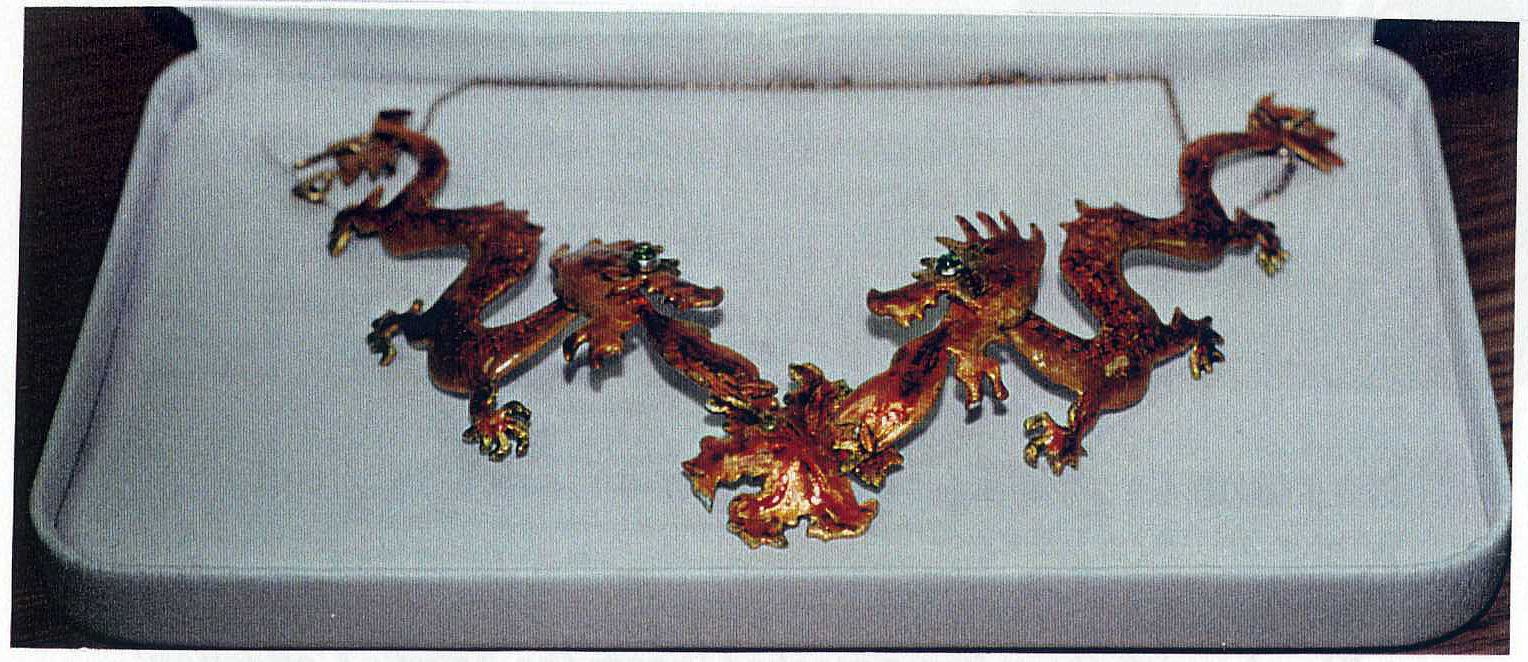
Each piece - tails, bodies, heads, tongues and the ball of fire in the centre is separate, connected by tubing rivets with tiny flame shaped enamelled heads. This allows the whole thing to move and settle itself in wear.
Anne Dyer
When the enamelling session is over, it offends me to let that heat just go. So, I have taken to using it to slump glass, to make flat glass into bowls or shards into pendants, earrings or suncatchers. This only works in a well-insulated kiln, as the cooling down must be as slow as possible or the glass will crack. And you need the kiln pretty hot to start, as the glass needs to get to about 850° to melt together.
Arrange any bits of broken bottle or window glass, glass beads or other glass scrap on a piece of whatever form of ceramic fibre you use, safely bigger than the glass area, on a mesh stand and put it in the kiln. Turn off the power and leave it alone until at least the next day.
At the York Conference everyone admired her beautiful panels and were delighted that, at last, May achieved 'Craftsman' level. One of her pieces was entitled 'Dance of the Spirit' and she has allowed us to publish the notes she wrote for selection. How well they show that she is an expert dancer as well as enameller.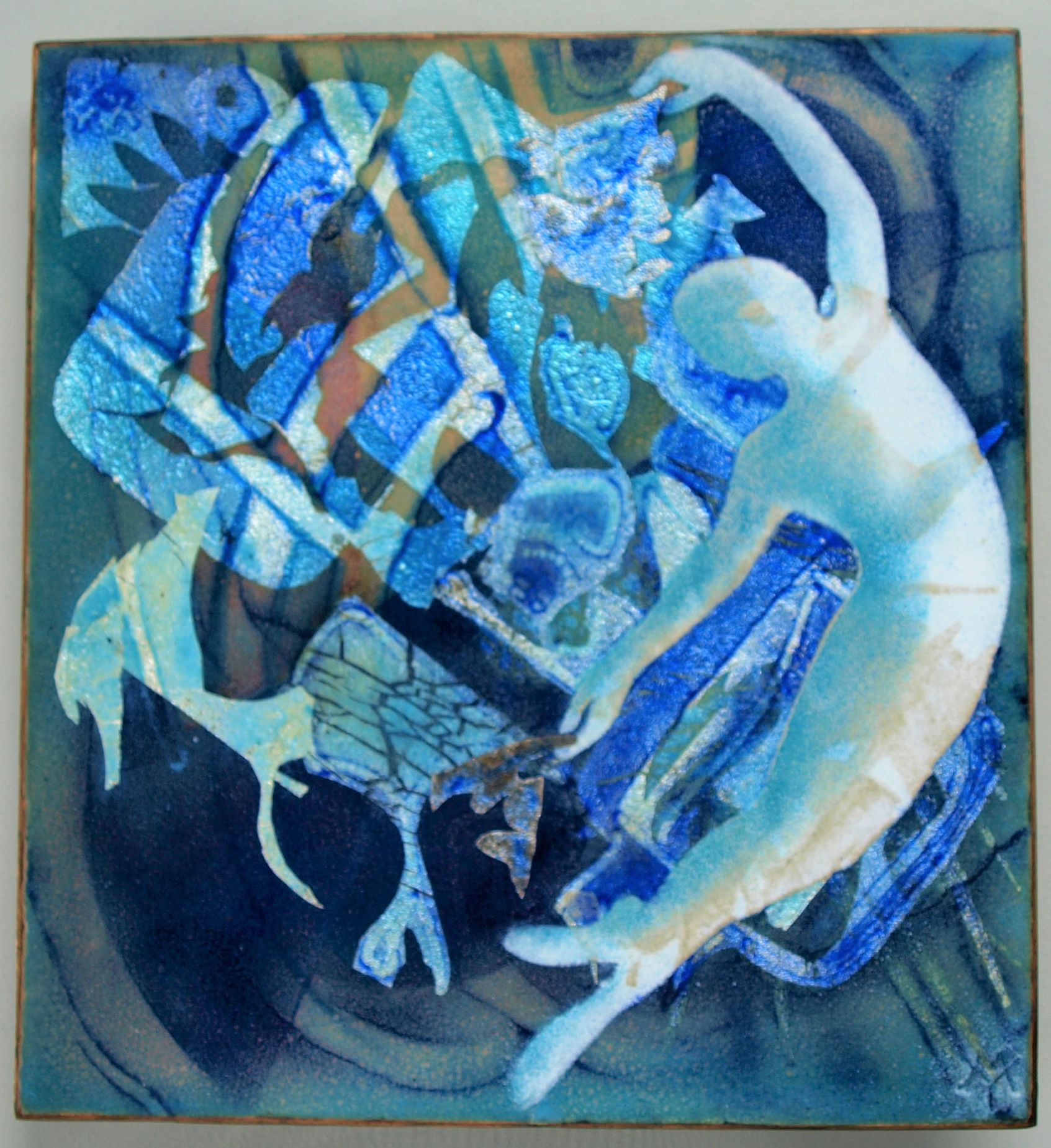
DANCE OF THE SPIRIT
The theme of this mural is joy in the form of both physical and spiritual dance. The gliding figure emanates feelings of peace and harmony through movement, extending through time and space in the vibrational colours of blue and silver.
I wanted to try to capture the feelings of delight, of expanded awareness and beauty which I have experienced through the physical process of dance and to convey these to the onlooker. The mural also seeks to represent visually the expression of music through dancing and the inspiration and impetus music gives me to move in rhythm and harmony with it. I sense colour in both movement and music, they inspire me to create and to go both within and beyond myself.
The luminosity of enamels, coupled with the subtle sheen of silver were qualities I tried to use to visually express these feelings. Gleams of gold express sunlight and elation; light greens and deep blues, swirls and linear shapes hint at reaching out into space.
In August 1979 1 visited the annual Gem Fair in the Crown Hotel at Harrogate, intending to purchase slices of agate, carnelian, etc. My interest at that time was in the making of leather belts and handbags, using the old Spanish technique of carving the leather; the stones were intended to be utilised for making fancy buckles for the belts, a very successful combination. At the Fair I purchased some 'Western' type buckles with a bezel on them to take a 30-40mm cabochon stone. Hans Theilade and his daughter were demonstrating enamelling, on his stall lay several 30-40mm blanks which had been decorated using small transparent mosaics; I picked one of the blanks up, trying it on the buckle - the effect was magical. After buying a few examples from him, I was becoming interested and decided to pursue the subject further.
Progressing further through the exhibition, my next discovery was that the Guild had a small stand of exhibits manned by Peter Wolfe and Ken Jones. On display were Peter's lovely falcons, also a plaque of a starling amongst apple blossom, a remarkable piece of cloisonnéwork. Ken showed the large perforated bowls which were inspired by caterpillar eaten cabbages, that may sound a little weird, but they were built up leaf by leaf and then enamelled in Thompsons 'forsythia'. One of Maureen Carswell's exhibits also fascinated me, a plaque of the scarlet berried woodland plant "Lords and Ladies".
Joan Bolton King
Richard Casey recently showed a lucky group of WAG members several time saving ways to use sgraffito in enamelling. This was a useful reminder to those of us who had attended his entertaining past tutorials at Conferences, but he also showed us yet another very effective procedure based on the use of both sprinkled and liquid enamels.
For this technique Richard uses John Ball's wet process enamel when it is in a wettish slushy consistency, considerably thicker than that used for dipping - hence his terming it 'slush'.