
A special work of Dudley College Supported Learning Students
Kathleen Kay
At the end of term nearing the close of 1999,I introduced to my four groups of enamelling students an idea for a rather special project to remind us of a rather special year.
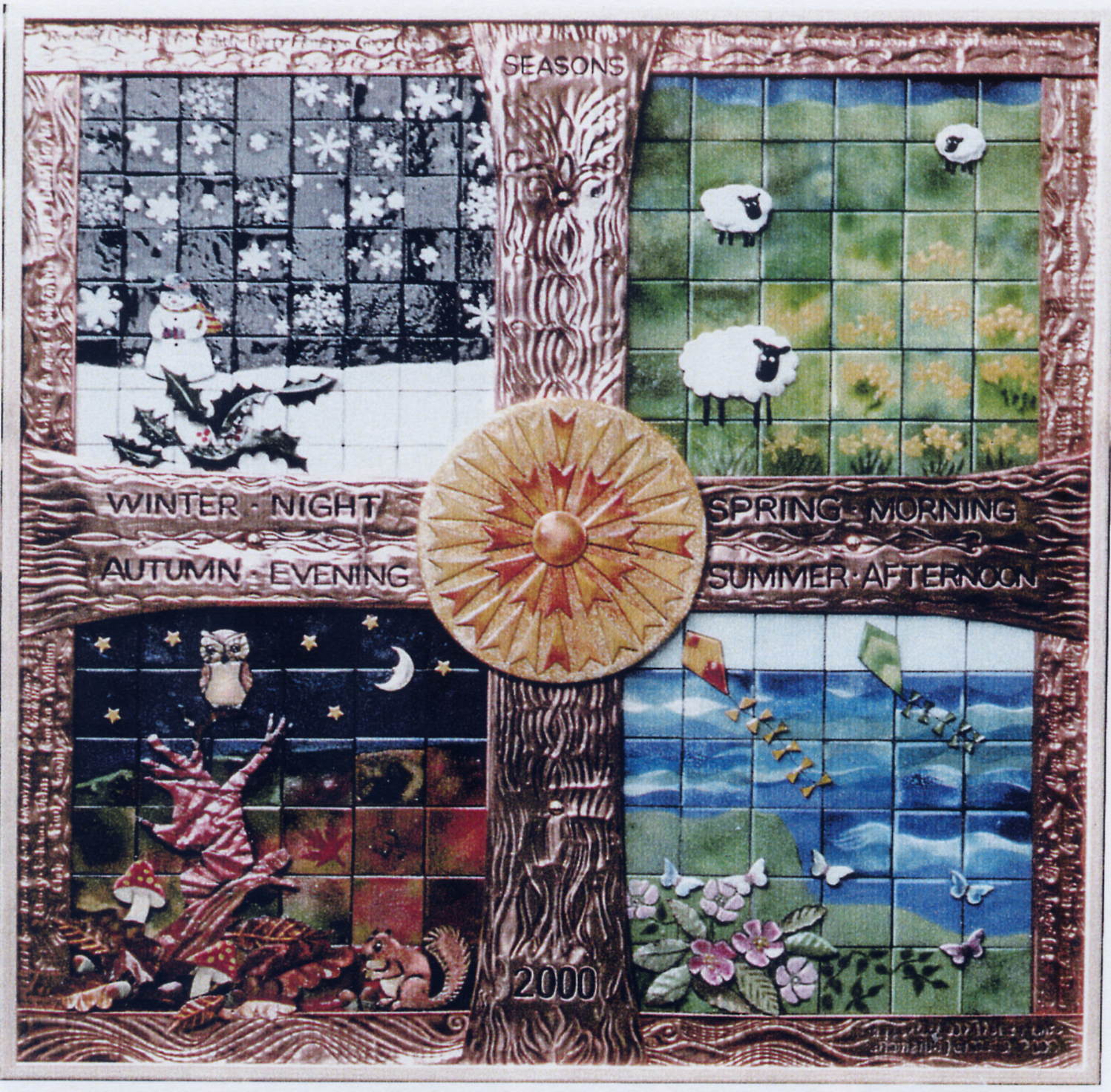
Each student was to be involved in the discussion of ideas and decisions relating to the detail, and even the beginners, working to each one's individual level of ability, would contribute to its production.
We were going to commemorate 2,000 years AD, a cycle of 2,000 years' seasons around a central sun. The four seasons we would separate by the Christian symbol of the cross.
If I had been producing this as a personal project, the whole panel would have been a large circle, but I had to consider the practicalities of co-ordinating the work of about thirty-six people and assembling the whole panel when all the small pieces were finished. Squares are much easier to cut and arrange.
Kathleen Kay
Texture and Surface Design are themes included in the City & Guilds Creative Studies Design Core Unit.
This is a folder, or book, of design ideas and creative play produced by each student and relevant to the chosen craft. It is really quite fun to do, even though you may not be able (or even wish) to follow an accredited Creative Skills course, and, if you want to have-a-go at part of my Enamelling on Copper version, I will try to guide you through.
I was amazed and pleased to have so many friends at Conference come to me to say how much they enjoyed and found useful the previous articles on Colour, Line and Shape. It's good to know that I am not writing just for my own amusement or diversion. Perhaps at next year's Cirencester Conference we could set aside a table to display any Creative Vision - Fired Play books which you are all rushing to start now? Ideas could be swapped or borrowed and, who knows, by Conference 2003 they might be finished, useful works.
Kathleen Kay
So, what is copper shim? Sometimes called foil, sometimes sheet, for our purposes it's a strong but soft, malleable metal which we can cut with scissors, texture, form and, of course, enamel thus making it stronger.
Copper sheet is available in many thicknesses; any technically minded enameller might first rummage in their make-up bag or pocket for the micrometer to check the thickness of the copper, which might be sold in Imperial thous., metric points of a millimetre or Standard Wire Gauge. To give a clue to the confused, a fairly small copper blank, which a catalogue will tell us is 22 gauge, roughly translates to 27 thou. or 0.7 millimetre thickness. Copper blanks of 20 gauge are thicker, at 0.9 mm.
Kathleen Kay
Following my article in the previous Journal I hope to inspire less experienced enamellers to play with some design ideas, using a variety of decorative media and the simple technique of embedding. By experimenting with opaque and transparent powders, firing temperatures and timing it is possible to control the amount of 'slump', relief or texture on the surface of the enamel.
To just touch on simple theory, we must be sure that our first firing of enamel has been hot enough to achieve fusion with the metal, otherwise at some time everything will pop off. This applies to both the front and the counter-enamel. For subsequent front layers, as long as our choices of enamel powders are compatible, we can either lower the firing temperature or give a much briefer firing, sufficient to fuse enamel to enamel and to just hold our decorative additions in place. As an example, this is best described by firing enamel threads. Transparent enamel threads, fired into a soft, transparent enamel powder for an average 2 minutes at 800°C, will probably have spread in varying widths, according to the original size, maybe merging into neighbouring threads (particularly if using transparent yellow/green threads), and the whole surface will be smooth and flat.
The extreme opposite is to fuse threads that are temporarily held, in the precise position, on the thinnest sifting of fine grains over the previously fired same surface colour.
Linda Connelly
The following depict ways I have successfully made beads from copper foil. You will probably be able to think of variations. You need to complete all repouseé work before rolling the bead. Remember, this texture will add strength and rigidity to the finished piece.
1. Rolling a bead using a bead making machine.
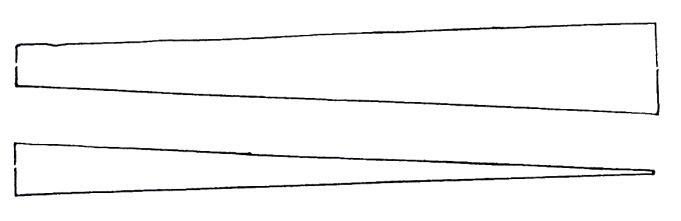
Pattern
Add simple texture with dots or squiggles.
Roll from widest end on to spindle or around a pencil
Use liquid flux for first firing