
Mike Warren
A lot of household water taps eventually lose their pristine appearance, often through general wear and tear, but usually with the red and blue tops deteriorating.
These are often made with a plastic insert, which may become water stained or even lost. Most can be easily prised off carefully in order to give access to the tap washer. Many of the houses which Moyra and I have lived in have had this easy facelift done to the taps and we have had a lot of comments made about them.
Having managed to obtain the inset from the tap, the main task is obtaining a copper blank the same size. This can be cut using a fretsaw, or I do not think there would be any difficulty in buying circular blanks the right size from the numerous commercial ones on offer, the only decision, flat or domed ?
Joan Bolton King
In this final part I want to consider making more three dimensional and free-standing pieces and to mention some of the ways other enamellers have used copper shim or foil.
More Three-Dimensional Ideas
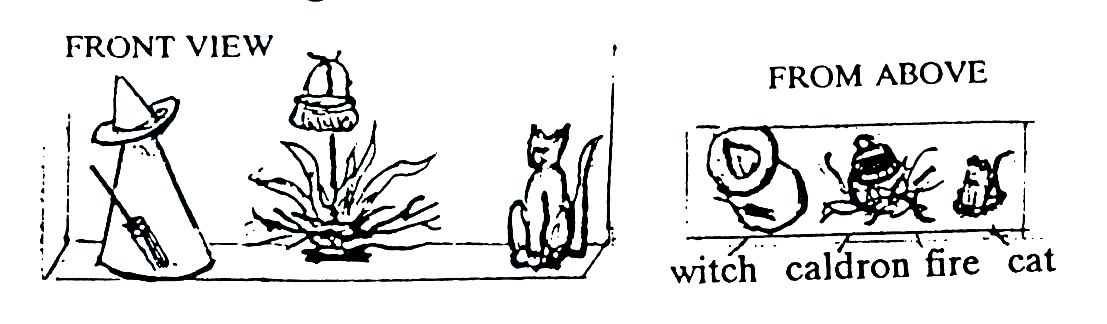
Relatively flat pieces are easier to enamel than ones "in the round", but anything is possible with care and the use of glue and bent wire stilts for supporting (or hanging up) some of the bits in the kiln. A tableau picture could be a good intermediate exercise.
Kathleen Kay
A short introductory piece aimed at newcomers to enamelling - sometimes overlooked; we shouldn't assume that everyone knows the basics.
Looking through the illustrated catalogues, first find the range of circles - you may wonder who would ever wish to enamel something so tiny as 8mm or even less. These copper blanks are manufactured to the standard 'cabochon' calibrated sizes used in lapidary and gem craft, where stones and jewels are hand or machine cut to fit exactly into commercial settings (see Manchester Minerals and Fred Aldous catalogues). These settings may be made up as brooches, bangles, cuff links, tie pins, pendants, earrings etc., and made from a cheap base metal or more expensive silver or gold; the price will reflect the metal value. The space for our copper blank will be consistent with the cabochon range.
Kathleen Kay
How many of us were first drawn to enamels by appreciating those wonderful colours that combine to make truly artistic works? Our enamel palette is so amazing, with well over a hundred colours listed in the catalogues and, depending on how we use and fire them, many of the colours can be made to appear lighter, darker, brighter, duller, speckled, shaded, shiny, matt, textured or smooth. To a confused beginner it's not easy to know where to start. Sometimes we may own so many colours that we forget to experiment with just one, seeing how many variations can be achieved with white for instance; thin or thick layers, underfiring, normal firing, overfiring and high firing, depending on the white used, can even produce lovely shades of pink, greys or green. Taking time working with our own colours, making notes and test pieces labelled on the reverse, we will have our own samples to arrange and compare giving inspiration and a choice of colours that are proven achievable.
Joan Bolton King
If you have been working through this series you will have already learnt much about my methods of producing repousse pieces. Here are some simple developments that can be incorporated with them.
Adding Silver Foil
It is easy to cover an enamelled piece of shaped copper shim with silver foil, especially if it is convex. This is particularly effective for insect or fairy wings.
Standard enamelling techniques apply. The foil will readily wrap round small enamelled bits when a smooth base coat (I usually use liquid flux) has been moistened (with a lick?). Tuck the edges gently underneath so they will fuse to the counter enamel leaving a silvered top - ready for further enamelling.